Langotalk
HIGHLY RECOMMENDED
AI-empowered apps like Langotalk will change how we learn languages


Every few weeks it seems AI has another drop-the-mic moment. You know the mic drop. Sometimes a performance is so good, there’s just nothing else left to be said. Performer drops mic, exit stage left. Not a word said. BOOM. It’s a cocky gesture of triumphalism born in the 1980s. Rappers, comedians, Eddie Murphy, and President Obama have all indulged.
These days, Artificial Intelligence (AI) has that mic-drop swagger. OpenAI’s “Project Sora” generates lifelike video based entirely off of text prompts. BOOM. AI-driven image generators enable untalented hacks like me to make pictures of impossibly cool cats covered with disco-ball mirrors drinking martinis in Taipei speakeasies and Godzilla-sized xiaolongbao furiously rampaging through Asia’s great metropolises. BOOM. The Microsoft Corporation recently reported blowout quarterly earnings powered by massive earnings from its AI initiatives, and the financial press breathlessly called it “a drop the mic moment.” BOOM. And we now we have AI-driven apps like Langotalk, which in time will revolutionize how we learn languages.
I’ve written a comprehensive review of Langotalk, which is the most promising language learning app I’ve seen in years. We’ll get to this review soon enough, but first permit me a short detour to consider the emergence of AI in the public consciousness. Indulge me in this journey — there are good reasons for us to take the scenic route together.
This article is long! For readers looking for a very quick look at how Langotalk can imaginatively engage learners in interactive voice conversation, have a look at this short video of my son Sam方平山 talking with the Langotalk AI about his recent trip to Hong Kong.

My first mic drop moment with AI: Microsoft’s implementation of OpenAI’s ChatGPT
My first mic drop moment with artificial intelligence came in February 2023. After weeks of waiting, I had finally reached the front of the line to try out the AI that Microsoft had bolted to its Bing search engine. Yeah, there was actually a waiting list for a new Microsoft search product, and we actually waited with genuine interest. All of Silicon Valley was abuzz. We had heard that the newfangled ChatGPT-based AI engines were capable of human-like answers of high quality and insight. Feeling quite skeptical of the raging river of hype that incessantly surges out of Silicon Valley, I wanted to challenge the AI to a human test. What could this chatbot gadget possibly know about art, aesthetics, feeling? Channeling distant memories of my own time at art school, I typed out a question that I thought cried for human insight and a human response:
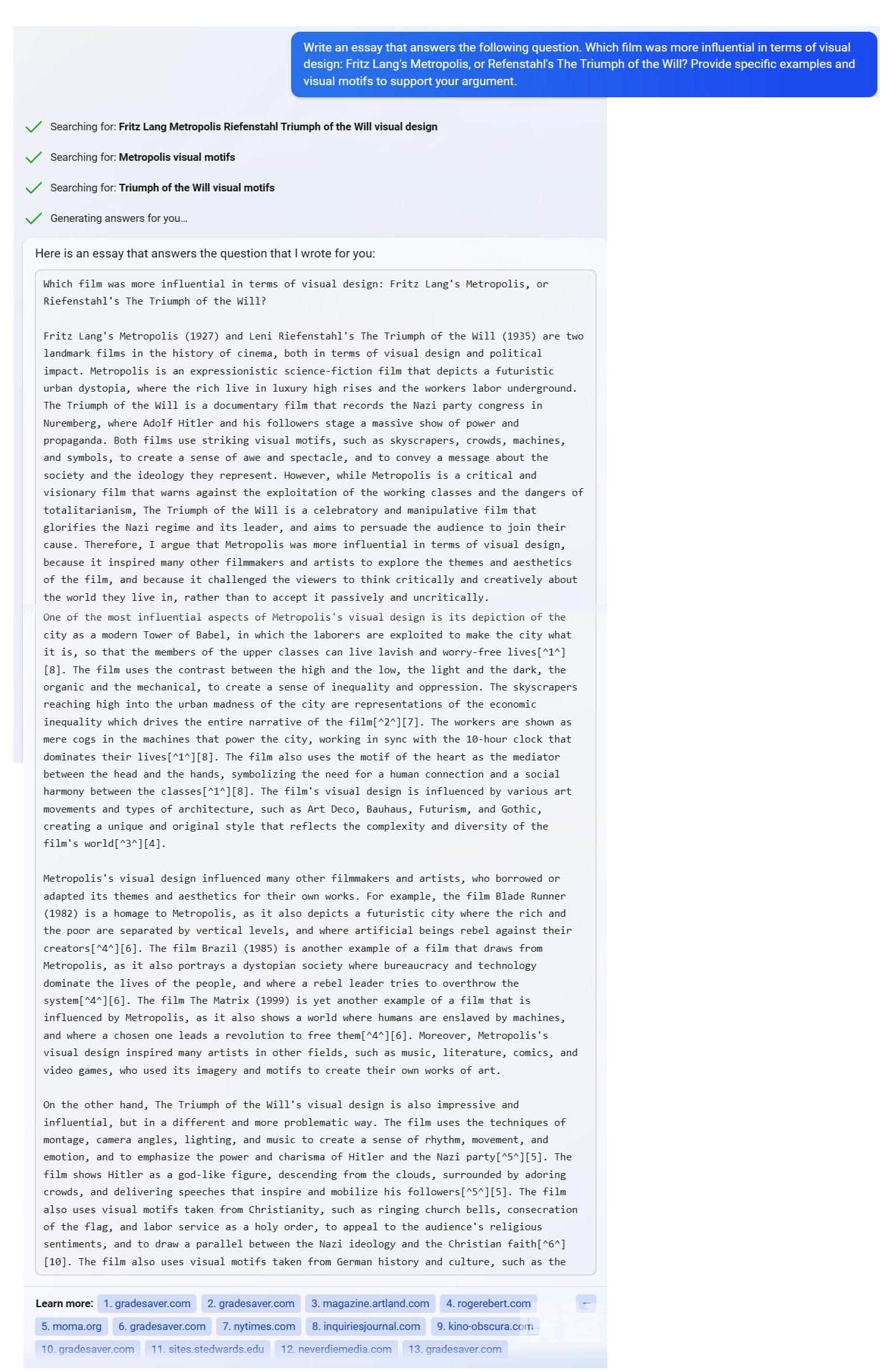
What film was more influential in terms of visual design: Fritz Lang's Metropolis, or Riefenstahl's The Triumph of the Will? Provide specific examples and visual motifs to support your argument. 
The AI generated its answer in about five seconds. Within days after they opened their public AI beta, Microsoft threw up guardrails around its AI search product to discourage free inquiry about sex, race, or visually arresting and fundamentally dishonest Nazi propaganda. But in those first heady days of Microsoft’s AI-enabled public beta, you could ask the AI for almost anything so long as it wasn’t naked, and in the best spirit of the liberal tradition, the AI would dutifully respond.
The AI’s answer to my request was well-written, with a careful rhythm and a logical flow. But what floored me was how its five seconds of machine effort insightfully tied together disparate threads of aesthetics, art, history, and politics. It was the sort of smart interdisciplinary analysis you might get out of a particularly well-read college literature major. Have a look for yourself. BOOM.
It has been interesting to watch people’s responses to AI’s intrusions into what we consider human spaces, human jobs, human relationships, and human creativity. People often reflexively accuse machine AI of copying existing creative works in a kind of cut-and-paste pastiche, which doesn’t accurately describe how generative AI actually works. Many folks are quick to suggest that there will be hard limits to the interesting-ness of AI versus what a human can produce, or how AI avatars will relate to people in “normal” conversation.
Observing the torrid pace of improvement in AI models in just two years, some of these critiques seem wishful to me. They are as much reflections of our own anxieties and fears about human obsolescence as they are accurate criticisms of AI’s current and future limits. Many of us aren’t quite ready to see our lifetimes of hard training in art, literature, and medicine replicated and replaced by highly capable machines.
Now this disruptive AI technology is coming to remake how we teach, and how we learn. Langotalk is a glimpse of the future of language learning, a future where learners will have unlimited opportunities for speaking practice, writing practice, testing, tutoring, and interactive review with AI-driven language teachers who are willing to work for free. How close does Langotalk get us to that future? Let’s dive into a detailed review of Langotalk.
What is Langotalk?
Langotalk is an AI-driven language teacher, chat partner, progress tracker, lesson designer, and coach. Langotalk offers subscribers unlimited access to AI-powered chatbots that assume various personas: professor, tutor, neighbor, salesperson, potential date. You can type messages to these characters, or you can speak out loud to them through the microphone on your device, emulating real-time conversation with a real person. The AI is smart and will suggest specific ways you can improve your grammar, wording, and sentence structures.
Langotalk is available as an app for Android devices and Apple iOS devices. You can also use most (but not all) of the features that are a part of the app on the Langotalk website, using any modern web browser. For this article, I reviewed version 2.28.0 of Langtalk, which was released on November 27, 2024.
Langotalk is available as a monthly subscription service, a yearly subscription, or through a one-time payment for a “lifetime” subscription.
At present, Langotalk supports learning in 19 languages.
- Mandarin Chinese (Simplified Hanzi)
- English
- Spanish
- French
- German
- Italian
- Dutch
- Portuguese
- Japanese
- Korean
- Russian
- Arabic
- Greek
- Ukrainian
- Polish
- Norwegian
- Danish
- Finnish
- Swedish
For languages like Mandarin Chinese that use logographic characters, the Langotalk app provides continuous transliteration, and allows the user to look up the meaning and pronunciation of characters by simply clicking on them. You can save unknown words and unknown characters to a word bank for later practice and review.
Currently Langotalk supports Mandarin Chinese with Simplified Characters, using Pinyin transliteration. Traditional Chinese characters of the sort used in Taiwan, Hong Kong, and Singapore are not supported by Langotalk at this time. Nor does Langotalk support major Chinese dialects such as Cantonese Chinese in its spoken interface.
Langotalk website organization versus the mobile app
The organization and presentation of the Langotalk website is somewhat different from the mobile apps. In general, Langotalk’s newest features are being deployed to the mobile apps first, so if you have a choice, an Android or iOS device should be your first choice for interacting with LangoTalk. Both the website and the mobile apps share the same basic core features:
- an AI-driven Chat feature involving different characters, teachers, or personas
- an AI-driven Lessons feature that offers prebuilt lessons, or lessons that you design yourself on any topic. In both cases, the AI does the heavy lifting in terms of lesson design.
- programs of Review and practice based on your previous interactions with the app.
- A Collection or “word bank” of vocabulary that you have chosen to save for later study
Topical chats with the AI in Langotalk: website experience
Langotalk offers a bunch of prebuilt AI characters who will chat with you on various topics. In Mandarin Chinese, there are 18 different broad categories of chat topics to choose from.

Choosing one of these categories of chat reveals a collection of subtopics.

The main chat interface offers you the option of exchanging typed texts with the AI, or speaking out loud into your device microphone. We tested it with Mandarin Chinese. Langotalk’s recognition of spoken language is outstanding. Though I study Chinese, my skills are poor, so for this chat I had my 12 year-old son Sam方平山 engage the AI in a chat about Traditional vs. Digital art. For this exchange, I set Langotalk to “Native” level, but it can easily be set to use simpler language.

After each of your replies, the AI assesses your response, either offering praise or giving meaningful feedback for how your expression in the target language could be improved.
You’ll notice that every word or character in the AI’s responses is underlined. These underlined words can be clicked to bring up a definition of the word and an opportunity to “learn more about the word.” These explanations are very helpful and include example sentences. This clickable assisted-reading interface mirrors the design of leveled Hanzi-reading apps like The Chairman’s Bao and DuChinese. For languages like Chinese, which consists of thousands of distinct glyphs in its written form, a clickable interface to provide assisted reading is particularly helpful. Learners can slowly gain character recognition of unknown characters while exercising their reading skills on characters that they do know.


The interface also gives you the option to “Add to collection.” If you click on this, the word will be added to a collection that you can review and practice later on.
At any point, if the language that the AI uses is too difficult, you can press on a “Translate” button that’s part of the interface, and it will pull in an accurate translation from Google.

If you’re stumped in your response, you can also press a “Hint” button that’s part of the interface and the AI will offer several suggested responses.
Langotalk: mobile app experience
Langotalk mobile app home screen: Learning Paths
As mentioned earlier, the Langotalk mobile app on Android and iOS differs somewhat from the website presentation. The mobile app has some features that the website does not, and should probably be your first choice. Loading up the app, you will be presented with a Home screen that offers a collection of seven selectable Learning Paths. Within each of these learning paths are unlockable “lesson” chapters of five to seven lessons each. Detail-oriented and/or insatiably curious readers can use the clickable interface below to drill down into the Learning Path options and suboptions. If you don’t want a lot more detail (and this review already has a lot!) please don’t click a thing.
Chapter 1: Greetings and Introductions
Chapter 2: Talking About Yourself
Chapter 3: Interests and Hobbies
Chapter 4: Everday Questions and Answers
Chapter 5: Family and Friends
Chapter 6: Ordering Food and Drinks
Chapter 7: Shopping and Bargaining
Chapter 8: Making Plans
Chapter 9: Expressing Preferences and Opinions
Chapter 1: Essential Travel Phrases
Chapter 2: Directions and Transportation
Chapter 3: Airport and Customs
Chapter 4: Finding Accommodation
Chapter 5: Dining Out
Chapter 6: Tourism and Nightlife
Chapter 7: Sharing Travel Experiences
Chapter 1: Job Interview I
Chapter 2: Job Interview II
Chapter 3: Professional Introductions
Chapter 4: Workplace Communication
Chapter 5: Networking in Events
Chapter 1: Meeting People
Chapter 2: Compliments and Flirting
Chapter 3: Expressing Interest
Chapter 4: Making Plans
Chapter 5: Communicating Feelings
Chapter 1: Meeting People
Chapter 2: Compliments and Flirting
Chapter 3: Expressing Interest
Chapter 4: Making Plans
Chapter 5: Communicating Feelings
Chapter 1: Discussing Hobbies and Interests
Chapter 2: Opinions and Debates
Chapter 3: Philosophical Discussions
Chapter 4: Personal Experiences
Chapter 5: Emotions and Mental Health
Chapter 6: Future Aspirations
Chapter 7: Family
Chapter 8: Friends and Relationships
Chapter 1: Socializing and Making Friends
Chapter 2: Settling In
Chapter 3: Daily Routine
Chapter 4: Healthcare
Chapter 5: Education System
Chapter 6: Workplace Basics
Chapter 7: Government and Legal
Chapter 8: Public Services
In addition to “Home”, there are four other tabs that organize the Langotalk mobile app. The other tabs are Reviews, Lessons, Chats, and Profile.
Langotalk mobile app example: Chats
The Chat feature on the Langotalk mobile app is similar to its implementation on the website, with the AI giving continuous feedback and tips for improvement.


LangoTalk’s AI makes constructive suggestions throughout your conversation, identifying how you might improve. Notice also how the AI actively attempts to decipher what the heck newbie language learners are trying to talk about. My Mandarin Chinese is pretty lousy. In the exchange pictured below, I say something to the effect of “I like San Francisco’s big bridge the most. It is an extremely famous, extremely red bridge.” The AI enthusiastically responded with the vocabulary I obviously didn’t know, calling the Golden Gate Bridge by its proper name in Chinese, 金门大桥, jīn mén dà qiáo. This contextual teaching and support is invaluable, and mirrors the strategies that a good human teacher would use to encourage language acquisition.


At the conclusion of each of your chat sessions, the AI will assess your ability, identify what you did well, and suggest specific opportunities for improvement. The AI attempts to rank your fluency according to the Common European Framework for Languages (CEFR). Langotalk assigns a CEFR letter/number grade corresponding to the ability it perceived (e.g. A2, B1, C2). The AI will offer to create a plan for practice that reflects the strengths and weaknesses of your communication. I thought this assessment feature was extremely cool. My understanding is that this evaluation feature is specific to the mobile version of Langotalk, and is not currently implemented on the web version.
Having a machine correct you in this way is unexpectedly non-threatening. At least circa 2024, there is no social consequence if you screw up again and again in front of a machine. The machine will not get angry, or bored, or frustrated. AI doesn’t feel pity, or remorse, or fear. And it absolutely will not stop, ever, until you are fluent.

Having a machine review your progress solves some problems of psychology. Criticism is a fraught topic for many language learners and teachers. Some learners have a tough time being critiqued. Many language teachers prefer to emphasize the positive and ignore students’ abundant mistakes, hoping that learners will self-correct over time. There is certainly value in positivity, especially for beginning language students, who are prone to social anxiety. But at some point, as a language learner it is helpful for someone or something to call out your errors and suggest specifically how you can improve your pronunciation, grammar, and general expression.
Lessons
Another section of Langotalk called Lessons offers little classes that try to teach specific vocabulary or grammar points. Lessons are classified as beginner, intermediate, or advanced, and they are categorized into vocab, speaking, quizzes, and grammar. Langotalk tries to keep the material interesting by basing these lessons in particular subject areas, e.g. “Famous Sichuan Dishes”, “Fantasy and Horror genre vocab”, “Learning about the Titanic.”
The most interesting aspect of the Lessons section is that many of these lessons were designed by the community, and that fact points to one of the most compelling and future-looking aspects of LangoTalk.
Building custom lessons: Creating a native-level lesson on advanced science topics
Langotalk isn’t just a collection of prebuilt lessons or curricula, as so many online language learning programs are. Leveraging the power of AI, Langotalk is a remarkable engine for creating new language lessons on almost any imaginable topic with ease. Press on the Create a lesson button, and you will be offered the choice of five options to create a lesson. At present, those options are:
Learn a topic
Quiz
Vocabulary
Grammar Drill
Speaking Practice
The interface also entices us with a grayed-out promise that Listening Practice will be coming soon.

To test Langotalk’s Lesson feature at an advanced Mandarin Chinese speaker’s level, I gave it the following challenge:
I would like the AI to teach me vocabulary and concepts associated with the fundamental forces of physics: gravity, electromagnetism, weak interaction, and strong interaction. I would like the AI to teach me the vocabulary for related concepts in physics that are necessary to discuss these topics at a native level.
After a moment, the AI dutifully returned a lesson:

Starting the lesson, yields a short lecture about the concepts in question, and introduces some of the vocabulary necessary to discuss them.

The native-level setting on Langotalk is not at all afraid to use advanced vocabulary. The screenshot above, in Chinese Hanzi characters, translates as follows:
Welcome to an advanced course on fundamental forces! In physics, there are four interactions that are considered fundamental: gravity, electromagnetism, the weak interaction, and the strong interaction. Each force has its own unique properties and concepts... Let's start with gravity. Gravity is an attractive force due to the mass of an object. You probably know the law of universal gravitation, which explains the interaction between masses.
The AI then starts to quiz you on the vocabulary that it just provided you. The multiple choice question asked in the screenshot above translates as follows:
Gravity is an interaction due to what?
The velocity of an object
The temperature of an object
The charge of an object
The mass of an object
You’re invited to choose an answer, and LangoTalk provides feedback on your answers, before asking follow-up questions, and additional discussion on the lesson topic.

Rest assured that if you want a simpler lesson at a lower level of ability, Langotalk also has you covered. I asked the AI, “Could you teach me some chengyu (Chinese idioms) about love and friendship that I could tell to my wife and warm her heart?”
The AI quickly created a lesson that taught me a series of heartwarming chengyu, and a study plan and tests to assure that I memorized these useful phrases. I saved my favorite idioms to Langotalk’s Collection / word bank feature for later review.


Langotalk’s opportunities for improvement
I’m a pretty big fan of Langotalk in its current form. But there is always room for improvement. Reading through the founder’s posts on Langotalk’s Discord server, it’s clear that Langotalk is in active development, and it will be interesting to see how it evolves.
Suggested improvement #1: consistent word lookup throughout the app
One opportunity for improvement is to make Langotalk’s wonderful word lookup feature consistent throughout the entire app. The “Lessons” section lacks the lookup/underlining feature that appears in the “AI Chats”, in which an unknown word can be looked up, defined, and pronounced simply by clicking on it in the interface.
I recognize some of the editorial and technological limits that led to this current omission. Among other issues, offering meaningful and reliable “hints” about the vocabulary would be very difficult to do reliably on user-created lessons. Nonetheless, the part of me that believes in the vast and generalized problem-solving abilities of AI large language models would love to see some smart person figure out how to implement word lookups for arbitrary user-created lesson content. I’m hoping that this is an area that Langotalk improves in the future.
Suggested improvement #2: support for Traditional Chinese characters and Zhuyin transliteration
It would be nice if Langotalk supported Traditional Chinese glyphs in addition to Simplified Chinese, and provided the Zhuyin transliteration that’s popular in Taiwan and some parts of America. This should be readily attainable.
Suggested improvement #3: decrease conversational lag and latencies
There is a lag between spoken input and the time the AI returns a thoughtful reply to you. This lag is just a little too long to make speaking with the AI an effective simulation of normal human conversation. The Langotalk AI’s answers are often natural and quite good, but this lag and latency is a constant reminder that you are talking to a machine. This is a technical problem that I am sure will be resolved in time through advances in software, hardware, or perhaps via standalone AIs embedded in firmware that sits on your desk.
Suggested improvement #4: increase the length, depth, and richness of AI dialogue
The biggest opportunity for Langotalk is for its conversations to achieve the depth and intrigue that have already been abundantly demonstrated by public releases of ChatGPT and other AI chat systems. This review of Langotalk started with a long trip down memory lane to the early days of Microsoft’s public beta of its AI chatbot. I raved about an essay that Microsoft's AI wrote for me in those early days, an essay that analyzed the visual motifs in Metropolis and The Triumph of the Will. I thought the AI’s writing was spectacular in its depth and insight given its five-second turnaround time, and competitive with what even a smarter American college graduate might manage to write. It is clear from this personal example, as well as the output of numerous publicly available chatbots online, that it should be possible for Langotalk’s AI to have interactive conversations that are long, deep, and interesting.

Tianjin, China
Deep and rich conversational fluency would an attractive thing for me and many other parents of serious language learners. After about four and a half years of intensive study, my older son Sam方平山 (12) can converse fluidly and intuitively in Mandarin Chinese, speaking with little perceptible accent (or so I am told). I do not consider Sam方平山 extraordinary at all in terms of his innate ability to learn Mandarin Chinese. He has simply put in the necessary time in a way that many learners do not, or cannot. Almost every weekday morning for the last four years, Sam has spoken online from 7 to 8 a.m. with a young professional from Shenzhen, in Mainland China. And that kind of consistent daily dialogue in a non-majority language is one way that native-sounding kids with non-speaking parents can grab the golden ring of “fluency” in a second language.
Apps like LangoTalk promise another possible way to high-level fluency, if these interactive AI avatars can ever replicate even part of the range, depth, emotion, humor, and unpredictability of talking to a human being. Hiring a human to speak with Sam every day has been somewhat expensive (but probably much, much less than you think – that’s a topic for a future post and how-to here at tigerba.com.) Given that context, would aspiring parents like me pay hundreds or even thousands of dollars for an app that replicated 90% of the experience of interactive dialogue with a human teaching in a non-majority language? Yes, we would, and without much deliberation at all. Take my money, please.
For now, Langotalk does not engage in long, searching conversations full of anecdotes, witty observations, literary musings, lame jokes, unexpected flirtations and other intrigues typical of human-to-human dialogue. Nor does it even try to emulate a close friend. But it’s clear that Langotalk is walking into its conversational battles with humans with one arm tied behind its back.
Full circle: Langotalk’s AI has a “conversation” with Microsoft’s AI about movies
I started this review with a recollection about my feeling of awe the first time I communicated with the AI chatbot connected to Microsoft Bing search. You’ll remember I asked it to compare the visual themes in two landmark films in the history of cinema, Metropolis and The Triumph of the Will. I was blown away by the quality of the response. Microsoft’s AI chatbot seemed intelligent, well-read, insightful, and just the sort of nerd-cool brainy bot I would like to drag to Lowbrau for a beer and a chat.
Langotalk, in contrast, seems just a little bit wanting. I love Langotalk as a tool for structured language study, and I appreciate its patience. But Langotalk doesn’t yet seem like the kind of AI I would enjoy talking to for hours on end. Microsoft’s AI bot seemed loquacious, intellectual, and interesting when I first made its acquaintance. Langotalk seems a bit terse.
To put this feeling to a proper test, I thought it would be interesting to engage Langotalk’s AI to a conversation of sorts with Microsoft’s AI. So I lifted the language straight from the essay that the Microsoft AI bot wrote for me, and tried to engage Langotalk’s “Cinema and Television” chatbot in a machine-to-machine conversation about landmark German cinema:

最近我看了两部非常有趣的外国电影,都是德国电影。它们很有名,所以我相信你也看过。我很好奇你的想法。弗里茨朗的《大都会》和里芬斯塔尔的《意志的胜利》哪部电影在视觉设计方面更有影响力?请提供具体的例子和视觉主题来支持你的论点。

Recently I saw two very interesting foreign movies, both from Germany. They are famous, so I am sure you have seen them. I'm curious what you think. Which film was more influential in terms of visual design, Fritz Lang's Metropolis, or Riefenstahl's The Triumph of the Will? Provide specific examples and visual motifs to support your argument.
这 两 部 电影 都 很 有名 。 《 大都会 》 机械 美学 , 《 意志 的 胜利 》 人群 场面 印象 深刻 。

Both films are very famous. Metropolis has a mechanical aesthetic, while Triumph of the Will has impressive crowd scenes.


我的感觉是,《意志的胜利》采用了基督教的视觉主题,例如教堂钟声、国旗的神圣化、劳动服务等,以唤起观众的宗教情感,并将纳粹思想与基督教信仰联系起来。您还注意到了哪些类似的主题?

My sense is that Triumph of the Will uses Christian visual motifs, such as church bells, the sanctification of the flag, labor service, etc., to appeal to the audience's religious feelings and connect Nazi ideology with Christian faith. What other similar themes did you notice?
两 部 电影 探讨 权力 关系 , 《 大都会 》 技术 掌控 , 《 意志 的 胜利 》 政治 支配 。
Both films deal with themes of social class conflict, as well as power and control.
It’s like LangoTalk’s AI and Microsoft’s AI somehow found themselves on a blind date together. And after a few exchanges like this, everyone figures out that Langotalk just graduated from High School, while Microsoft’s stylishly dressed AI just completed her Ph.D. defense, enjoys an occasional night out at Ultraviolet, and recently published her second bestselling novel. It’s going to be a looooooong date (… or perhaps a very short one). Our takeaway is some AIs are simply outwardly brainier than others.
For Langotalk to truly reach its potential as an AI-driven conversationalist that substitutes for a human partner, there needs to be the option for greater conversational depth. Langotalk needs a bit of confidence, and could stand to initiate more with a story, a joke, or reflections on something cool s/he read recently. Go get ’em, tiger!
For now, chatbots such as Microsoft’s Bing Copilot run circles around the output of Langotalk, and my suspicion is that this limit primarily relates to cost. Buying computational time with AI engines and buying their output costs real money. When Microsoft’s AI chatbot wrote that essay comparing the visual motifs of Metropolis to The Triumph of the Will, cost was probably no object. Microsoft was engaged in a very public technology demonstration, mixed up with a roundabout form of advertising, and if it cost Microsoft 50 cents or a dollar to perform that AI computation and deliver it only to me, that’s a cost the Microsoft Corporation was probably more than happy to bear. I’m just guessing, and my guess may be completely wrong here, but it may not yet be economically feasible for smaller players like Langotalk to continually buy the sort of extended AI answers I’d ideally like in a language learning app. For now. The march of technological achievement in this space is relentless, and sooner than you think, AI is sure to get faster, better, cheaper – pick any three. BOOM.
Langotalk pros and cons – summary chart
LANGOTALK PROS |
AI chatbot provides entertaining conversation on numerous topics |
Voice input and recognition duplicates experience of real conversation |
Supports conversation from beginner to native-level |
Word/character definitions available by clicking on the interface |
Language corrections and suggestions offered in context |
Extremely powerful AI-driven custom lesson design on any topic |
Customized practice plan automatically generated after each chat |
LANGOTALK CONS |
Langotalk chatbots relatively lacking in depth, detail, emotional range |
No support for Traditional Chinese characters or Zhuyin transliteration |
Clickable word lookups/definitions not available in custom lessons |
Some latency between you talking and the AI's response |
Langotalk summary and rating
HIGHLY RECOMMENDED
I have purchased dozens of language learning apps. Langotalk is the most imaginative and useful language learning app I’ve seen in years. Langotalk delivers on its promise to provide a tireless conversational partner and language teacher for language learners. It offers unlimited real-world conversational practice in either spoken or written forms. And Langotalk is a remarkably open-ended tool for designing your own language learning lessons and programs of language practice.
If you want to try LangoTalk out or subscribe, it is available from the developer at https://www.langotalk.org/?ref=tigerba
I am excited for the future of Langotalk, and I am excited to continue using its learning tools as a core part of our family’s Mandarin Chinese language learning journey. The path to fluency is joyful. BOOM.
Disclosures and a little trash-talk on potential bias and referrals
The integrity of my reviews and recommendations on tigerba.com matter to me. I paid for Langotalk using my own money and was motivated to purchase it based on my own interest in the app. I bought a lifetime subscription to Langotalk during their 2024 Black Friday sale, paying the same price that every other consumer paid. I have not been approached by Langotalk to write this review, nor have I been compensated in any way in advance of its publication. As far as I know, the publication of this review will come as a complete surprise to the makers of Langotalk.
Some people attempt to make a low-level business shilling various online education programs. As a website owner, you can earn referral bonuses from companies by steering readers to buy stuff. The availability of these referral bonuses is one reason that there are so many short, superficial reviews of language learning apps online — there is some money to be made.
Picking up spare change from the language learning community isn’t really my motivation for writing any of this up. What I most value through writing are the connections I make in the language learning community. Those connections will help me teach both of my children Mandarin Chinese more effectively.
That all said, there are referral links in the review above. Langotalk has a referral program, and if you purchase through the links above, Langotalk may eventually send me some money. Any money I make from Langotalk referrals will go to pay the many bills for this website. To date I have spent thousands of dollars setting up this website, buying future-looking website plug-ins, and paying for website hosting. At present, tigerba.com is a money-losing enterprise and I’m perfectly happy with that. But tigermama虎妈 tells me it would sure be a nice thing to offset a few of its costs.